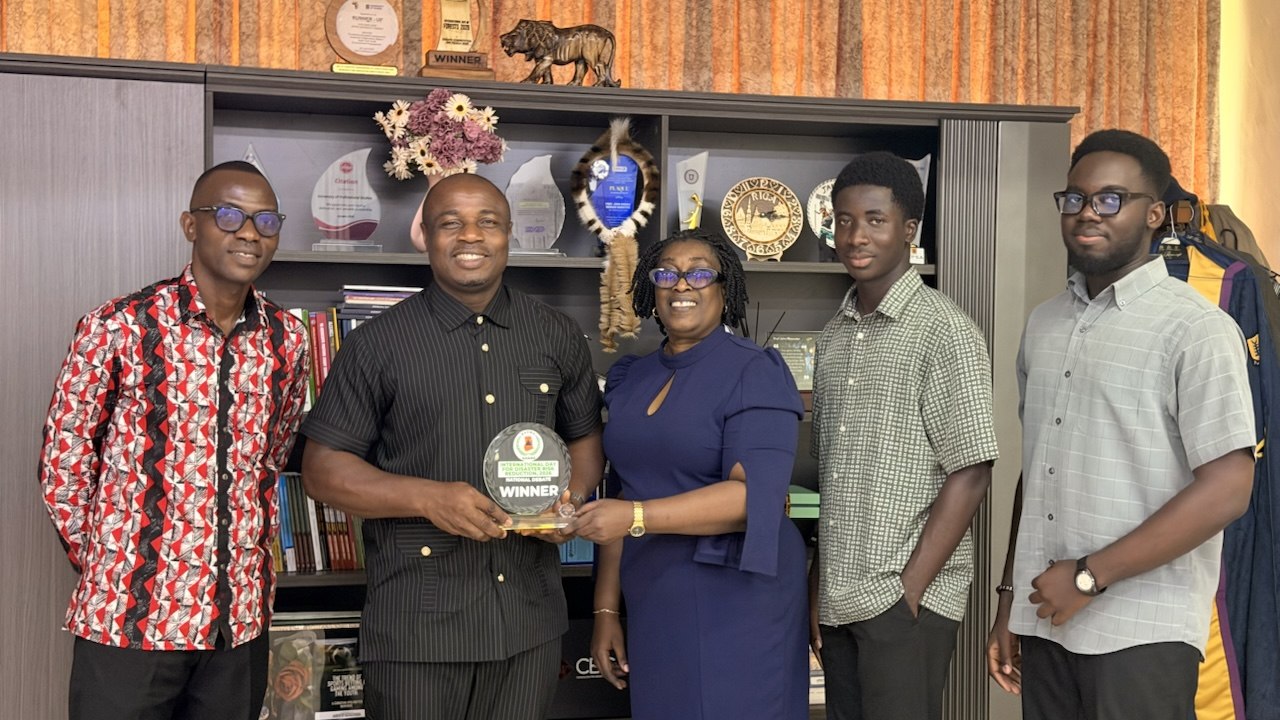
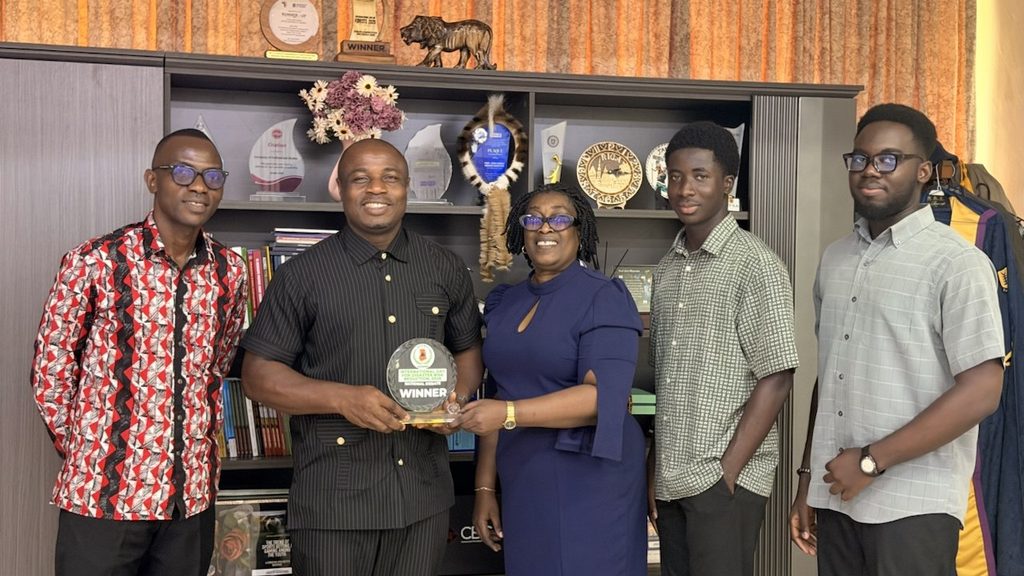
The University of Professional Studies, Accra (UPSA) has won the International Day for Disaster Risk Reduction (IDDRR) Inter-School Debate, adding to its debating achievements this year. The competition, organised by the National Disaster Management Organisation (NADMO), took place on Friday, 16 October 2026, at the Centre for Biodiversity Conservation Research, University of Ghana.

Held under the theme “Resilience Starts at Home”, the competition provided a platform for students to examine disaster preparedness and resilience. UPSA was represented by McKenzie Abeasi Damprani, Pearl Heston and Sylvanous Kofi Akakpo, who secured victory with a score of 348 points.
Presenting the opposition’s case, the UPSA team emphasised the role of wider systems and institutions in enabling households to prepare for, respond to and recover from disasters. Their arguments highlighted the relationship between household preparedness and the institutional support needed to strengthen resilience.
A distinctive feature of the team’s presentation was a live demonstration of Ready Home, a prototype family emergency plan generator, by third speaker McKenzie Abeasi Damprani. The demonstration illustrated how technology could support household emergency planning, giving practical expression to the issues explored during the debate.
The NADMO victory followed UPSA’s second-place finish at the Day of Scientific Renaissance of Africa (DSRA) 2026 Climax Debate, held on Tuesday, 30 June 2026, at the Cedi Conference Centre, University of Ghana.
At that competition, McKenzie Abeasi Damprani, Emmanuel Twumasi Awuah and Sylvanous Kofi Akakpo represented the UPSA Writers and Debaters Society and the Department of Communication Studies. The team argued against the motion, “For Africa’s Equitable Development, Research Collaboration Matters More Than Youth Empowerment Programmes,” and finished as runners-up.
Together, the performances highlight the students’ ability to examine complex questions, construct persuasive arguments and communicate ideas effectively. Their participation also underscores the value of debating as a platform for intellectual enquiry, public engagement and the application of knowledge to societal challenges.