
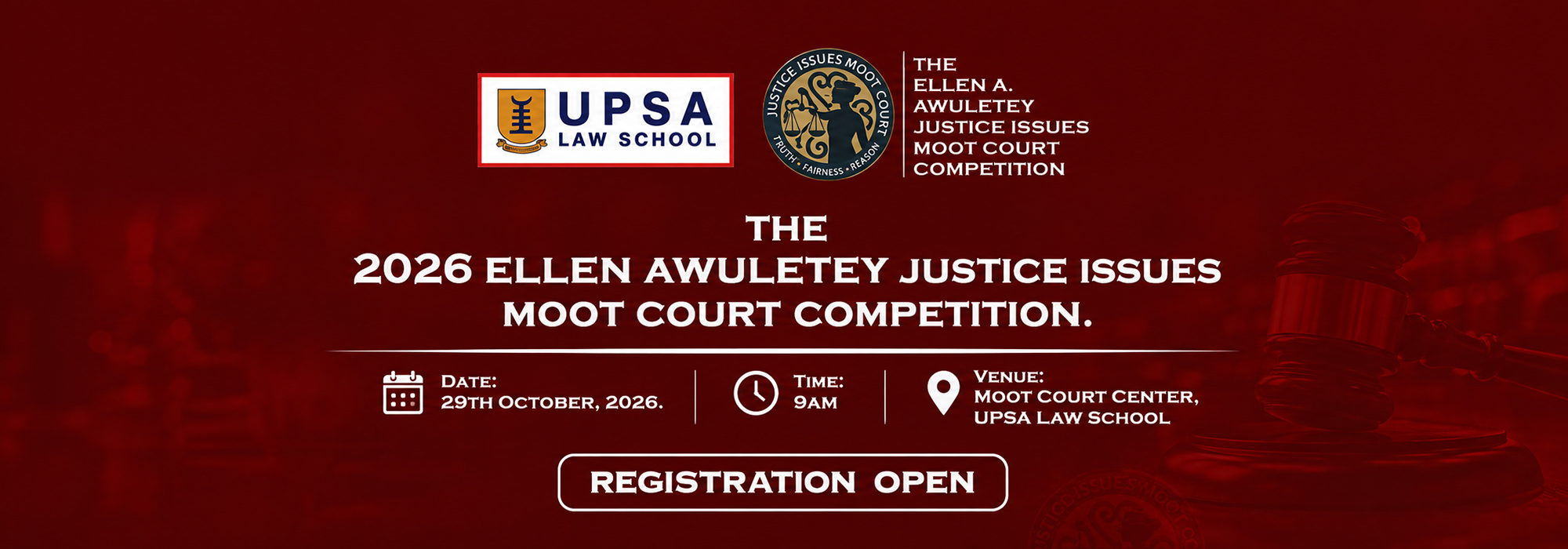
The Ellen A. Awuletey
Justice Issues Moot Court Competition
A simulated courtroom competition for LL.B students, hosted by UPSA Law School. Teams brief and argue justice-issue matters before panels of judges, scored across written memorials and oral advocacy.
Rule 1: General Provisions
The competition fosters legal research, advocacy skill, and professionalism by placing participants before panels of judges to argue cogent positions raised in written submissions. All proceedings are conducted in English.
| Rule | Description | |
|---|---|---|
| Eligibility | 1 per team institution | Teams must consist of students currently enrolled in a recognised law school or institution reading the Bachelor of Laws (LL.B) programme. Each institution may only register one team to participate in the competition. |
| Official Language | English only | All written submissions and oral arguments must be made in English. |
Key Dates
Two hard deadlines govern the season: clarification requests, and memorial submission. Mark both.
| Date | What Happens |
|---|---|
| 28 Aug 2026 | Deadline for written requests for clarification on the moot problem, sent to [email protected]. |
| 4 Sep 2026 | Administrator’s responses to clarification requests issued by this date. |
| 4 Oct 2026, 11:59 PM | Memorial deadline. Both Applicant and Respondent memorials due by email. Missing this without prior written Organising Committee agreement results in disqualification. Teams may resubmit without penalty up to this deadline. |
| Competition Day | Preliminary and Final Rounds are both held on the same day. |
Rule 2: Team Composition
Team Size | Each team shall consist of five (5) members, with a maximum of two (2) designated oralists for each round. Additional team members may serve as researchers or Of Counsel. |
Team Registration | Teams must provide the names of their members and any other required information in compliance with the registration procedure, which shall be provided at a later date. |
Rule 3: Anonymity of Teams
(a) Teams must not reveal the identity of their members or institutions on their memorials or to judges at any time during a Round. The Administrator may impose a Penalty (up to and including disqualification) against any team that intentionally or inadvertently violates this rule, whether or not such disclosure occurs during a moot. All instances of disclosure during a Round shall be reported to the Organising Committee of the competition.
Rule 4: Memorials
4.1. Submission of Memorials
- Unless otherwise agreed in advance and in writing by the Organising Committee, a team will be disqualified from the Competition if it does not submit both its Applicant and Respondent memorials by Sunday, 4th October 2026, 11:59pm. Memorials are to be submitted via email to: [email protected]
- In exceptional circumstances, a team which is disqualified under this rule may seek a dispensation from the Organising Committee after the disqualification deadline has expired. In such a case, the Organising Committee may impose any penalty short of disqualification that they consider appropriate. Equipment failure or problems will not be considered justification for improper formatting or late submission of memorials.
- Teams may resubmit their memorials without penalty until the memorial deadline.
4.2. Memorial Formatting
- All parts of each memorial must be contained in a single file. Memorials must be in Microsoft Word format. Memorials that do not conform to this rule will not be accepted. If a team submits its memorials in an unacceptable format, it may resubmit conforming memorials prior to the submission deadline.
- All pages of the memorial must have margins of at least one inch (2.54 cm) on all four sides. The font and size of the text of all parts of the memorial, excluding the cover page and page numbers but including the footnotes, must be in Times New Roman 12-point. The line spacing is recommended to be 5 lines, with the exception of the cover page, table of contents, index of authorities, headings, and footnotes (which can be single-spaced). A quotation from sources outside of the memorial may be block quoted (i.e., right and left indented) and single-spaced if the quotation (excluding footnotes) has at least 50 words. Memorial judges may consider formatting and presentation when they evaluate memorials, but teams will not receive memorial penalties for failing to adhere to the formatting recommendations in sub-part (c) of this rule.
4.3 Memorial Content and Structure
- The Memorial must contain the following parts in the following order:
- Cover Page;
- Table of Contents;
- Index of Authorities;
- Statement of Jurisdiction;
- Statement of Facts;
- Summary of Pleadings;
- Pleadings; and
- Prayer for Relief (or Conclusion).
- Apart from the cover page (which may contain the Justice Issues Moot Court logo), memorials must consist exclusively of text. Links may be included within citations to provide easy access to referenced sources. These links should be inserted appropriately within the citation, following an appropriate citation style.
4.4 Cover Page
The front cover of each memorial must have the following information:
- the Team Number in the upper right-hand corner followed by “A” if an Applicant Memorial or “R” if a Respondent Memorial (e.g., Team 123 would put “123A” on its Applicant Memorial);
- the name of the court (i.e., “the Supreme Court”); the year of the competition, the name of the case, and the title of the document (i.e., “Memorial for Applicant” or “Memorial for Respondent”).
4.5. Length
- The Statement of Facts, including the associated footnotes must be no longer than 850 words.
- The Summary of Pleadings, including the associated footnotes must be no longer than 600 words.
- The total length of the Pleadings and prayers (reliefs), including the associated footnotes must be no longer than 7000 words.
4.6. Citation Requirement
(a) Footnotes must be used to identify the source of statements or propositions made in the body of the Memorial. Full citations must be used in the footnotes of the Pleadings part of the Memorial the first time a source is cited. Abbreviating sources as defined terms or short forms of citations in the Table of Authorities is prohibited.
4.7 Plagiarism
Memorials must be original work and must be independently made by the teams. Plagiarism will result in disqualification.
4.8 Scoring
Memorials will be evaluated based on legal research, clarity, structure, argument strength, and adherence to the prescribed format. Memorial scores will amount to 30% of the total score.
Rule 5: Moot
5.1. General Procedures
- Each moot consists of 60 minutes of oral pleadings. Applicant and Respondent are each allotted 30 minutes (which includes rebuttals). Oral presentations during the Moot must be made by two members from each team. Prior to the beginning of the Moot, the team arguing as Applicant must indicate to the bailiff which team members will act as its first oralist and second oralist and how it wishes to allocate its 30 minutes among (a) its first oralist, (b) its second oralist, and (c) rebuttal. The opponent team must equally indicate the above team member roles to the bailiff and how it wishes to allocate its 30 minutes among (a) its first oralist, (b) its second oralist, and (c) surrebuttal.
- Time allocated to but not used by one oralist may not be used by the other oralist or saved for rebuttal or surrebuttal. The President may at their discretion extend the time limits stated above during a round.
- Any team member may act as an oralist during any moot in the competition and need not always argue the same side. One additional team member registered may sit with the two oralists as counsel. The person acting as counsel need not be the same person in each moot.
5.2. Three Judge Panels
In each moot, the Administrator shall employ three judges whenever possible and may employ more than three judges in elimination rounds. In extenuating circumstances, the Administrator may authorise panels of two judges. In no case may an Administrator authorise that a moot be presided over by a single judge. The Administrator may nominate one of the Judges on a panel to act as Presiding Judge. Where the Administrator does not nominate the Presiding Judge, the judges on the panel shall determine which of them is to act as such.
5.3.2 Rebuttal and Surrebuttal
Each team may reserve up to five minutes for rebuttal or surrebuttal. Teams should announce at the beginning of their oral argument whether they have reserved time for rebuttal or surrebuttal and how much time they have reserved, although a failure to do so will not entail a waiver of the right to rebuttal or surrebuttal. Only one of the two oralists may deliver the rebuttal or surrebuttal. Teams may waive their rebuttal or surrebuttal. If the Applicant waives rebuttal, then surrebuttal is waived as well.
5.4. Ex Parte Procedure
- When a Team fails to appear for a moot, the Administrator may allow the moot to proceed ex parte. In an ex parte proceeding, the attending team presents its oral pleadings, which are scored by the judges. In such a case, the team that fails to appear for its scheduled moot forfeits all six of the moot’s oral round points. However, where only one member of the absent team appears, that oralist shall be allowed to present their pleadings and receive an individual score.
- The Administrator may schedule an additional ex parte proceeding for the absent team later in the round if time and administrative concerns permit. The scores from the absent team’s ex parte proceeding are to be used only for purposes of calculating individual oral pleading scores.
5.5. Courtroom Communications
No communication is permitted between any persons without permission from the President other than: (1) orally, between a judge and an oralist at the podium or;
(2) in writing, between any two persons sitting at counsel table. The judges may, where necessary, communicate directly with an oralist, any team member at the counsel table of either team, and any other person present in the courtroom to ensure the orderly conduct of the in-person moot (for example, to clarify the spelling of an oralist’s name or to request that a person or persons remain quiet).
5.6. Spectators
The presence of Team Advisors or other spectators affiliated with the team is permitted in the courtroom in which the team is competing. Teams are responsible for ensuring that their spectators do not engage in any disruptive behaviour and shall ensure that spectators do not disclose to judges the identity of their institution or members.
5.7. Scouting
- Team members or persons directly affiliated with any team must attend only moots in which that team is competing and must not through any other means obtain or attempt to obtain information about another team. The Organising Committee may, in the interests of the Competition, (1) waive this rule, or (2) allow Team Advisors to judge, provided such Team Advisors offer no advice to the Team they advise about the Team(s) they judge.
- A team which commits scouting forfeits all oral round points in each round in which it competes against the team it scouted. Where, due to the schedule of rounds, the said teams will not meet in any contest, the applicable penalty may be imposed at the discretion of the Organising Committee.
5.8 Scoring Criteria
- The total score for the oral rounds is 100 points to be assessed as follows:
- Knowledge of the Law: Max Score 30
- Knowledge of the Facts: Max Score 20
- Questions & Answers: Max Score 25
- Style, Poise & Courtroom Etiquette: Max Score 15
- Organisation & Time Management: Max Score 10
- Further details shall be provided on the score sheets in each round.
- The Oral Rounds score shall amount to 70% of the total score in a contest and shall be added to the 30% score from the memorials.
5.8.1 Tie Breakers
Where teams are tied, priority shall be given in the following order:
- Higher oral scores
- Higher memorial scores
- Higher scores for response to questions
- Decision of the organizing committee
Rule 6: Round for The Competition
The competition shall consist of two main rounds: the Preliminary Round and the Final Round. Both rounds shall be held on the same day.
6.1 Preliminary/ Elimination Round
Through a ballot, each team would be paired with an opposing team for a contest. The side each team would argue in the preliminary rounds (i.e. Applicant or Respondent) would also be balloted for.
6.2 Final Round
The two teams with the highest average score from the aggregate rounds and the memorial scores would advance to the final round.
Rule 7: Corrections and Clarifications
Any request for clarifications in respect of the moot problem must be submitted in writing latest by 28th August 2026. Responses on clarifications to any of the above requests would be sent by the administrator latest by 4th September 2026.
Requests for clarifications should be sent via mail to [email protected]
Rule 8: Awards
8.1 Categories
Unless otherwise determined, the awards to be presented at the competition are:
- Award for the Winning Team
- Award for the Runner-Up Team
- The Best Memorial Award
- Best Oralist Award
8.2 Assessment Method for Determining Awardees
The Best Memorial shall be determined based on the average score obtained by a team for its Plaintiff Memorial and Defendant Memorial.
The Best Oralist shall be determined based on the individual scores obtained by each oralist in the preliminary rounds of the competition.