

The University of Professional Studies, Accra (UPSA) has deepened national dialogue on emerging financial technologies through the 14th Absa-UPSA Law School Quarterly Banking Roundtable. Convened by the UPSA Law School in collaboration with Absa Bank Ghana on Tuesday, 28 July 2026, the forum examined the theme, “Digital Assets Regulation in Ghana: Navigating Opportunities and Risks.”

The expert panel comprised Mr Philip Kwaw Sebuabe, Acting Head of the Virtual Assets Department at the Bank of Ghana; Kwesi Dadzie-Yorke Esq., fintech law expert and Co-Founder of Asiedu & Yorke; and Dr Virág Blazsek, Associate Professor of Law at the University of Leeds School of Law.

Mr Sebuabe explained that Ghana’s Virtual Asset Service Providers Act adopts a risk-based and technology-neutral approach, avoiding both an outright prohibition and an unregulated market. He said regulators had used a pre-legislative policy sandbox to study emerging business models and technologies before developing the operational framework.
He stressed that consumer protection remains central to the regime, with requirements covering capital adequacy, custody of client assets, and compliance with anti-money laundering and counter-terrorist financing obligations.

Mr Dadzie-Yorke described the Act as a significant step towards regulatory legitimacy for the digital asset sector. He noted that formal supervision could improve access to banking services, strengthen investor confidence and enable licensed operators to demonstrate their regulatory standing. He nevertheless cautioned that fraud, compliance costs and counterparty risks remain substantial, urging firms to adopt automated sanctions-screening systems and robust contractual safeguards.

Mr Sebuabe also outlined the coordinated roles of the Bank of Ghana, Securities and Exchange Commission, Financial Intelligence Centre and Cyber Security Authority. Under the framework, payment-related virtual assets fall primarily within the remit of the central bank, while assets with characteristics of securities are regulated by the SEC. He further highlighted the National Virtual Asset Literacy Initiative and efforts to deepen regulatory cooperation with Nigeria and South Africa.
Delivering the keynote address, Dr Blazsek examined the emerging regulation of central bank digital currencies. Drawing on comparative approaches in the United States and United Kingdom, she highlighted unresolved questions concerning legal classification, insolvency protection, interoperability, data protection and monetary sovereignty.
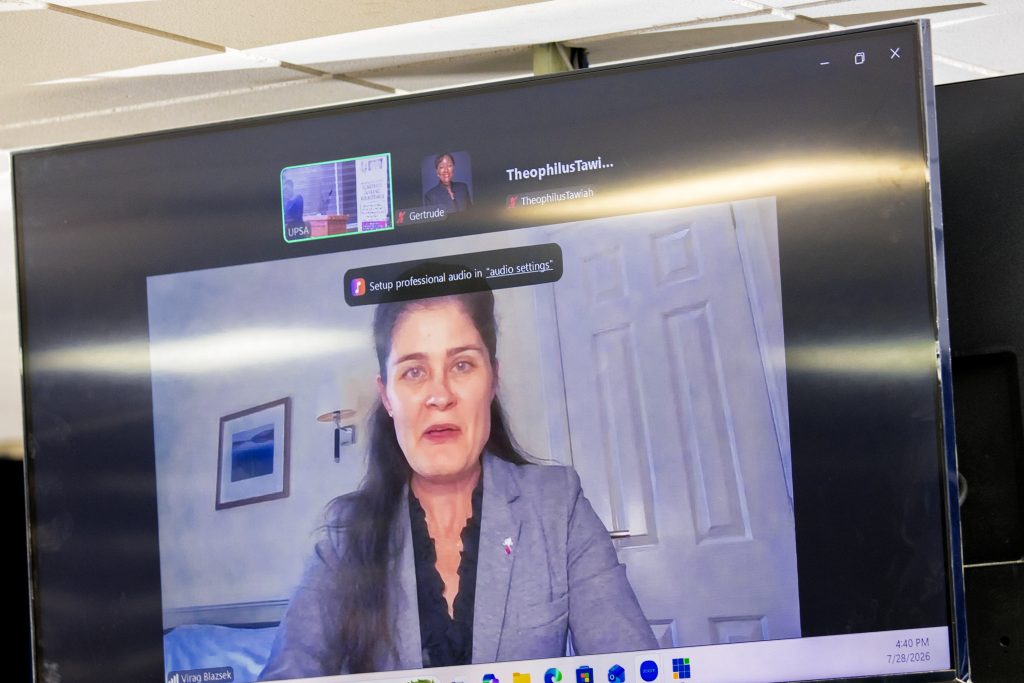
She also cited Hungary’s Student Safe initiative, the European Union’s first live retail CBDC pilot involving real users, as evidence that controlled experimentation can generate valuable regulatory insights without an immediate, system-wide rollout.
The panel agreed that Ghana’s principles-based framework provides room to respond to developments in tokenisation, decentralised finance and stablecoins. Mr Sebuabe, however, cautioned against foreign currency-backed stablecoins, describing the risk as “dollarisation on the blockchain”, while indicating that cedi-backed alternatives could be explored within a regulatory sandbox.
The roundtable reinforced the UPSA Law School’s contribution to informed policy dialogue by connecting academic inquiry with regulatory and industry expertise in support of Ghana’s digital financial transformation.